Dev 4 min read
LaraBug turns 10
LaraBug turns ten today. It took me three years to ship version 4, not because I lost interest, but because client work always came first. What I learned, for anyone building something next to client work.
LaraBug turns ten today. I've owned it for three of those years, and it took me all three to ship version 4. Not because I lost interest, but because client work always came first. If you're building something of your own next to client work, this is what I learned.
Dennis started LaraBug in 2016. In an article from 2018 he wrote that he created it "to basically scratch my own itch". He needed a clean tool to read his errors on, because users don't always report bugs. Five days ago I launched version 4.
How I got here
Dennis is the one who got me into programming. He gave me a roadmap to learn it by myself, and once I could do enough, he let me work on his ServerBuilds panel. When he sold ServerBuilds and started Ploi, I got to work on Ploi too. I still see him as my mentor.
In 2023 I bought LaraBug from him.
Three slow years
The first thing I did was performance. That was a tough job: six months, working half time on LaraBug.
After that it got slow. I'm a freelancer with my own studio, Intilli, so client work comes first and LaraBug got the evenings and weekends. In 2024 and 2025 together I made 113 commits to LaraBug's app. Enough for queue monitoring and a paid plan, and not much more. This year I made more than 2,000.
Quitting never crossed my mind. I wanted to launch it, I just didn't know when.
Why now
Everyone talks about AI writing code. Fewer people talk about what happens next: more code you didn't write line by line, shipped faster, breaking in places you didn't look. I wanted a tool that tells me right away when that happens, and shows me where my own applications can be faster. It's the same itch Dennis had in 2016, so this year I went all in.
That's what version 4 is built around. When something breaks, an agent can read the issue and its stack trace through LaraBug's MCP server, and Autofix, still in beta, opens the fix as a draft pull request.
What I underestimated
Everyone tells you to ship early. I knew that. What I underestimated is how a side project makes it harder: when you only have evenings, every release feels like it has to be worth the wait. So you keep adding one more thing. Between March 2025 and January 2026 I didn't publish a single release of the package.
Adham Dannaway posted a diagram this week that sums it up: tweak, tweak, tweak, back to the start, and "publish" never reached.
Then the beta started, and I shipped 23 versions in seven weeks. That's the pace I should have had from the start: small releases, quick feedback, real users telling me what's missing.
What LaraBug 4 does
LaraBug started as an exception tracker, and its Laravel package has been downloaded more than 700,000 times since, about 48,000 times a month right now. Version 4 is a lot more than an exception tracker:
- PHP exceptions and JavaScript errors (browser, Vue, React and Inertia) in one list, with the request, user and queries behind each one.
- Every request on one timeline: queries, cache calls, outgoing HTTP, mail and queued jobs.
- Twenty detections that open an issue without an exception, like a slow route, an N+1 query or a scheduled task that stopped running.
- A nightly check of your lockfiles against known vulnerabilities.
- Alerts on Slack, Discord, Microsoft Teams, email or a webhook.
- An MCP server, so an AI agent can read your issues and help fix them.
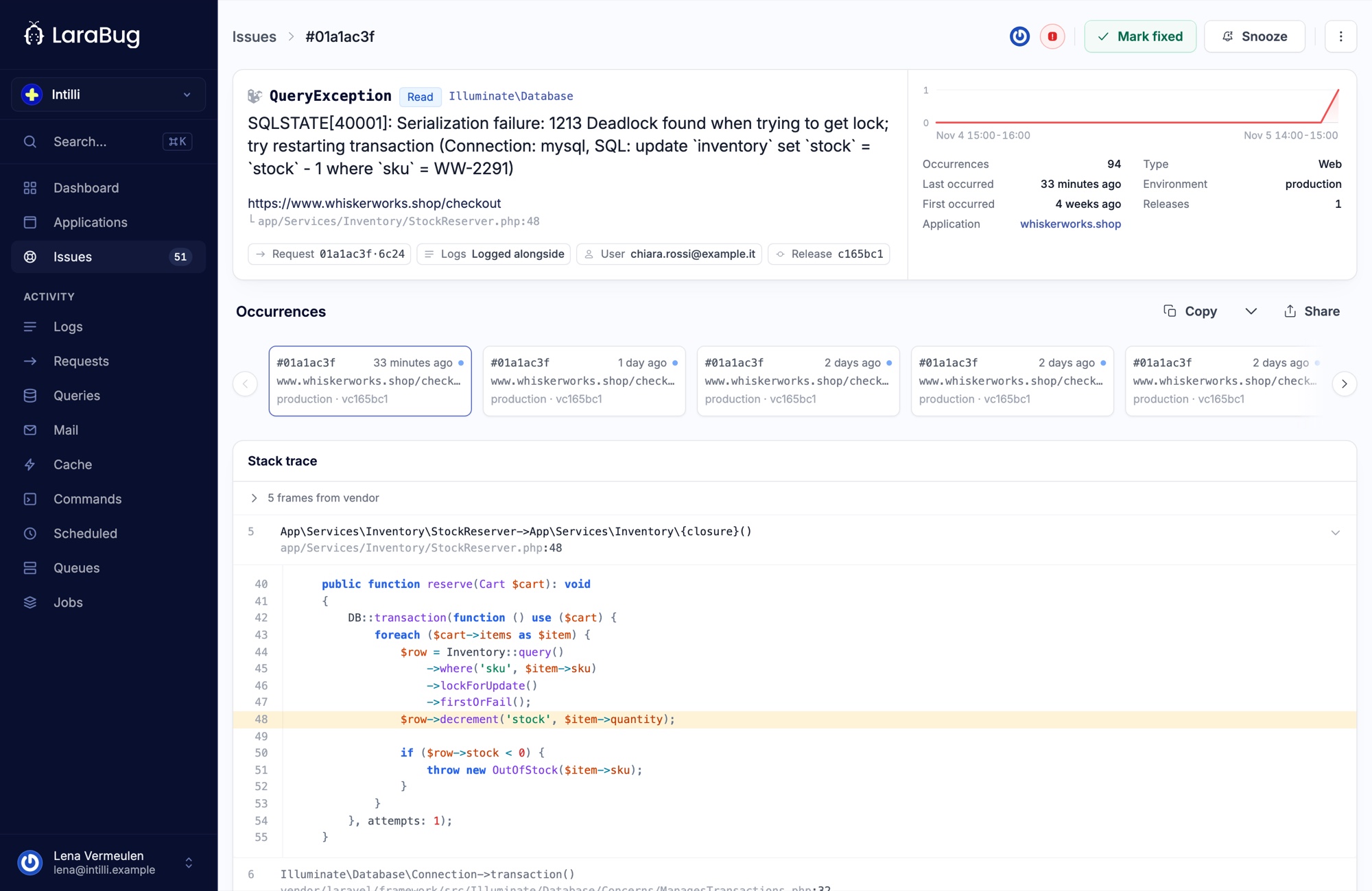
Installing it is one command, composer require larabug/larabug, and one DSN in your .env. The free plan stays free, and your data stays in the EU.
Launch day
On 16 November I shared it on X, in the newsletter and in a few communities. It felt like a weight falling off my shoulders. The response was alright and the feedback was hopeful, which after three years is exactly what I needed.
For everything that's new, check out the announcement.
That's it. Let me know what you think of version 4, and what I can improve.
Dennis, thank you.